You are here: home / phonological awareness
Phonological Awareness
Phonological awareness is an awareness and understanding of the sound structure of language.
A child or adult who is phonologically aware has developed the ability to consciously tune in to the sounds of spoken language, to understand them and to talk about them. For example, a three-year-old whose phonological awareness is developing might say something like: "Hey, cat-bat: they sound the same!" To which you might reply "Hey, they do, don't they? They both have an 'at' sound in them. Cat-bat, bat-cat!"
Now, if you've never heard the term phonological awareness before, you might already be thinking that this whole thing sounds way too confusing. But stay with me for a bit because, although it seems complicated, there's really only one thing we parents really need to know.
Phonological awareness develops naturally if you:
- read to your child;
- talk to your child;
- play with your child;
- give your child lots of interesting and varied experiences;
Sounds almost too easy? Sadly, many children these days are missing out on these experiences because mum and dad are simply too busy.
My children are all young adults now but I remember all too well how hectic life was when they were small and we were rushing around to and from school and daycare, play dates, sport and the shops. I was anything but a calm, happy parent!
But I've learnt a lot in the years since then and, as a primary school teacher, I now know how crucial basic experiences like these are for children. They're crucial for children's healthy emotional development and for their relationships and they're also absolutely critical for fostering the development of skills that create the foundations for learning to read when they're older.
Why Is Phonological Awareness Important?
Phonological awareness is an important and reliable predictor of a child's later reading ability.
We now have decades of research which clearly shows that children who have problems learning to read at school usually have poorly-developed phonological awareness.
Phonological awareness is an important and reliable predictor of a child's later reading ability
On the other hand, kids whose phonological skills are well-developed during the pre-school years often learn to read quickly and easily. Sometimes they even learn to read before they start school. In fact, they often learn to read quite naturally, with little in the way of formal teaching.
Sounds amazing, doesn't it? Yet, I've seen this happen with quite a few children over the years, including my own three children and my five nephews.
It was also incredibly obvious when I did my first teaching prac in a kindy classroom here in Sydney. Although this was in a fairly well-to-do area of the city, many children were not being read to by their parents at home. The differences between the two groups of children became very clear when they were reading to me and when they were doing their writing.
Phonological Awareness and Reading
Phonological awareness is one of the building blocks of learning to read. In fact it's a crucial building block without which children struggle to learn to read. The other two building blocks are a rich vocabulary and wide background knowledge.
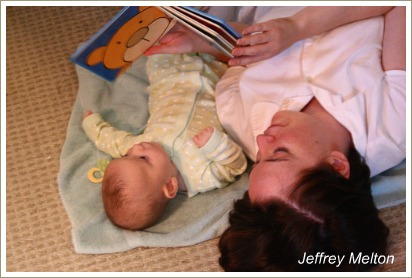
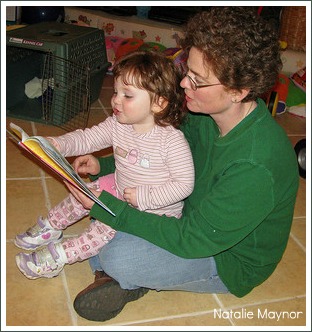
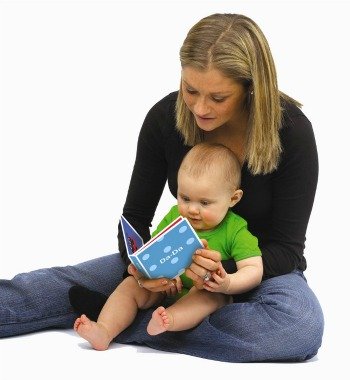
The very best way of helping your child develop these skills is by reading to him often and in the right way, starting as early as possible.
Poetry and rhyme in particular are great stimulators of phonological awareness. Luckily, human beings seem to be naturally drawn to language which features rhyme, repetition and an interesting rhythm. You can see this quite clearly when you read a poem or rhyme to a child. Even very young babies are usually entranced. That's why so many books for young children are written in rhyming verse. It's also why nursery rhymes have been popular for hundreds of years and why Dr Seuss books are so much fun to read with children.
Phonological Awareness: The Basics
Here are the main things to be aware of when it comes to phonological awareness.
Phonological awareness:
- is not the same as phonemic awareness or phonics. The terms are often used interchangeably, even by teachers, but they mean different things;
- relates only to speech sounds. Phonological awareness does not involve the letters of the alphabet, spelling or whole words. It does not involve reading or writing. Phonological awareness has to do only with the sounds we hear when we hear language spoken;
- is a listening skill, not a reading skill. It involves listening to spoken language and being able to distinguish rhymes, syllables in words and individual sounds in syllables
Phonological awareness develops:
- as part of overall language and speech development;
- generally in the third year of a child’s life. This is when a child's phonological awareness becomes noticeable however it develops because of activities that the child has been exposed to from birth;
- naturally if you read to your children, talk to them, share nursery rhymes with them and play games with them;
- can be enhanced through the kind of easy, fun, free activities we do with our kids, such as playing word games and clapping games and singing nursery rhymes while doing the actions;
The main thing to remember is that phonological awareness, like many things our children learn, is not something we need to actually teach our children. It will develop naturally if we read aloud to them and connect with them by giving them our warm, focused attention.
For more information about phonological awareness, you might like to have a look at this post.
References:
Center, Y. (2005). Beginning Reading. Sydney: Allen & Unwin.
Emmitt, M; Zbaracki, M; Komesaroff, L. & Pollock, J. (2010). Language & Learning. Melbourne: Oxford University Press.
Mayer, R.E. (2001). What Good is Educational Psychology? The Case of Cognition and Instruction, Educational Psychologist, Vol. 36(2), 83–88.
http://www.readingrockets.org/helping/target/phonologicalphonemic
You might also like: